How Long Does It Take a Mini Fridge to Cool?
A mini fridge usually takes 2 to 4 hours to reach a safe fridge temperature, and 12 to 24 hours to fully stabilize after its first plug-in. A warm room or a large load of food stretches that, while an empty fridge in a cool room cools fastest.
On this page (10 sections)
- How long does it take a mini fridge to cool on first plug-in?
- Why does a mini fridge take longer to cool than a full-size one?
- Does the type of mini fridge change the cooling time?
- How warm is the room, and where is the fridge placed?
- How full should the fridge be while it cools?
- How do you check that the fridge is actually cold enough?
- What slows down a mini fridge, and how do you fix it?
- Does moving a mini fridge reset the cooling clock?
- Which thermometer helps you track the cooling?
- What's the realistic timeline from plug-in to cold food?
A mini fridge usually takes 2 to 4 hours to reach a safe fridge temperature, and 12 to 24 hours to fully stabilize after its first plug-in. A warm room or a large load of food stretches that, while an empty fridge in a cool room cools fastest.
There's the first chill, when the cabinet drops from room temperature to something cold enough for food. Then there's the longer settling period, when the compressor stops cycling so hard and the temperature holds steady.
How long does it take a mini fridge to cool on first plug-in?
Plan on about 2 to 4 hours for the first real chill and up to a day for the fridge to settle. The compressor starts working as soon as power reaches it, but the cold spreads through the cabinet gradually.
Small thermoelectric models often need the longer end of that range, while compressor fridges pull down faster. The first hour or two is mostly about the walls and shelves absorbing cold.
The air inside gets cold before the surfaces do, so a thermometer reading can look right while the cabinet is still warming back up each time you open the door. That's why the full 12 to 24 hours matters before you trust the number.
Keep the door closed as much as you can during this window.
Why does a mini fridge take longer to cool than a full-size one?
Mini fridges cool slowly because their small compressors move less refrigerant and struggle to overcome the heat leaking in through their thinner walls. A full-size fridge has thick insulation and a large, heavy interior that holds temperature well once chilled.
A mini fridge usually has thinner walls and lighter shelves, so the cold it builds escapes faster when the door opens or the room is warm.
The compressor is also smaller and runs in shorter bursts. It can't dump heat as quickly, so the cabinet creeps down toward its set point rather than dropping fast.
That doesn't mean a mini fridge is a bad appliance. It means you should expect a patient first day and give the unit time to find its rhythm.
Our guide to how a mini fridge cools explains the compressor and thermoelectric designs in more detail.
Does the type of mini fridge change the cooling time?
Yes. A compressor mini fridge generally cools faster and holds temperature better than a thermoelectric one.
A compressor fridge uses refrigerant and a pump, much like a kitchen fridge scaled down.
It reaches cold temperatures quickly and recovers fast after the door opens.
A thermoelectric fridge uses a cooling plate and a fan, and it works best when the room is already cool. These units also struggle to drop far below the room temperature.
In a hot room they may never reach a true fridge setting, no matter how long you wait. That's a design limit, not a fault.
If you store perishable food, a compressor model is the safer choice. If you only chill drinks in a mild room, a thermoelectric unit can do the job once it settles.
How warm is the room, and where is the fridge placed?
A hot room slows cooling and a cool, shaded spot speeds it up. Mini fridges push heat out the back or sides, so the room they sit in directly affects how fast the cabinet chills.
Direct sun through a window, a spot next to an oven, or a closed cabinet with no airflow all make the compressor work harder. A garage that hits 90°F in summer can keep a mini fridge from ever stabilizing at a safe food temperature.
Leave a few inches of clearance around the vents so heat can escape, and don't tuck the fridge into a tight alcove or push it flat against a wall.
If the fridge is in a hot space, a fan moving air past the vents helps.
How full should the fridge be while it cools?
Start with an empty fridge and add food gradually once it's cold. An empty fridge chills the fastest because there's no food mass holding warmth.
Once it reaches temperature, you can load it in stages.
Add a few items, let the fridge recover, then add more.
Don't pack food tight against the cooling vent or the back wall. Air needs to move around the shelves for even temperature, and blocked airflow leaves warm pockets near the door.
Leaving some empty space also helps the fridge recover after you open it. A fridge stuffed to the door has no cold air reserve to give back.
How do you check that the fridge is actually cold enough?
Use a thermometer rather than guessing from how the shelves feel. A small digital thermometer gives you a real number to compare against a safe target.
The TempPro 2-pack has a large backlit LCD screen for reading in a dim fridge, plus a max/min record function that shows the past 24 hours of temperature swings. Its IPX6 waterproof rating suits the damp inside of a fridge.
Place one thermometer near the middle shelf and one near the door, away from the vent. Read them after a few hours and again the next morning.
A fridge that reads cold at night but warm by afternoon has an airflow or seal problem, not a cooling-time one.
Wait until the fridge holds 40°F (4°C) or lower before adding perishables. Check the reading with a thermometer before you load milk, meat or leftovers.
If the fridge is still above 40°F after 4 hours, give it more time and check the door seal and vent clearance.
Our guide to how cold a mini fridge should be covers safe targets for food, drinks and freezer compartments. For drinks-only use, a slightly warmer setting is fine.
For food, hold the line at 40°F and check it now and then.
What slows down a mini fridge, and how do you fix it?
Door seals, vent clearance, room heat and blocked airflow are the usual causes of a slow chill. Look at the door gasket for gaps or crumbs.
A seal that doesn't close flush lets warm air in constantly.
Wipe the gasket and close the door on a sheet of paper to feel for a loose spot. Clear space around the vents and pull the fridge away from the wall.
If it sits in a hot room, move it or add airflow.
A plug-in watt meter helps you see whether the fridge is drawing steady power. The MECHEER meter shows watts, volts and amps, and its data memory keeps the last reading after you unplug it.
If the draw looks normal but the fridge stays warm, the issue is inside the unit. Our guide to how long a mini fridge lasts helps you decide between repair and replacement.
Does moving a mini fridge reset the cooling clock?
Yes. After a move, let the fridge stand upright for several hours before plugging it in.
Handling a fridge can shift the compressor oil, and running it too soon can damage the unit.
Once it's upright and settled, plug it in and start the cooling clock again. The first chill may take a little longer than usual because the cabinet has warmed to room temperature.
Our guide to how to move a mini fridge covers the safe way to tip, carry and settle one. Give it time to rest before you expect cold air.
Which thermometer helps you track the cooling?
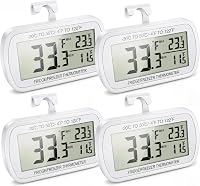
A simple digital fridge thermometer is the most useful tool for this job. The VOULOIR 4-pack reads from -4°F to 122°F with ±2°F accuracy and 0.2°F resolution.
Each unit has a 2.56-inch LCD showing current, max and min temperatures at once.
The magnetic back sticks to the side of the fridge, the hook hangs it on a shelf, and the IPX3 waterproof rating handles damp air.
Put one on each shelf if you want a full picture. The max/min function shows how cold the fridge got overnight and how warm it climbed when the door opened.
That's the detail a plain temperature check misses. For a single fridge, one or two units are plenty.
The rest can go in a freezer or a second fridge.
What's the realistic timeline from plug-in to cold food?
The first few hours get the fridge cold, but the full settle takes a day. Hour 1 to 2: the cabinet starts cooling and the walls feel cold.
Hour 2 to 4: the interior reaches a food-safe temperature in most models.
Hour 4 to 12: the temperature levels off and the compressor starts cycling less. Hour 12 to 24: the fridge holds steady, and you can trust the reading.
A hot room or a thermoelectric model pushes each step later. An empty compressor fridge in a cool spot lands at the fast end.
Use the timeline as a guide, then confirm with a thermometer before you stock the shelves. If the fridge hasn't reached 40°F after a full day, stop waiting and troubleshoot.
The problem is the unit or its placement, not the clock.
The TempPro 2-pack is the pick for tracking the first day, thanks to its backlight and 24-hour max/min record. The VOULOIR 4-pack suits checking several spots at once.
The MECHEER watt meter helps you rule out a power problem when the fridge won't chill. Pick the thermometer first, and let the numbers tell you when the fridge is ready.
Frequently asked questions
Can I put food in a mini fridge before it has fully cooled?
Wait until the interior holds a safe fridge temperature before adding perishables. Loading warm food into a warm cabinet slows the whole process and can leave items in the danger zone for hours.
Give it a few hours to stabilize, then check the reading before you fill it.
Does a mini fridge cool faster if I turn the dial to its coldest setting?
No. A colder setting makes the compressor run longer and adds strain without cooling the cabinet faster overall.
Set the thermostat to its normal range, let the fridge settle, and adjust only after you check the temperature with a thermometer.
Why does my mini fridge feel cold but not cold enough?
A fridge that runs but stays warm usually has an airflow or door-seal problem. Check that food isn't blocking the vent, the door closes flush, and the fridge sits away from heat sources.
If it still won't hold temperature, the issue is mechanical rather than a matter of cooling time.
How long should a mini fridge run on its first day?
Let it run continuously for the first 12 to 24 hours without opening the door more than needed. That stretch lets the compressor pull down the cabinet and the temperature level off.
Opening the door often during that window only extends the wait.
Does the room temperature change how fast a mini fridge cools?
Yes. A mini fridge sheds heat into the room, so a hot garage or sunny kitchen slows it down and a mild, shaded spot speeds it up.
Most makers design mini fridges for indoor use, so keep the fridge away from direct sun and other appliances when you can.