How to Troubleshoot a Mini Fridge
Start with the simplest checks: confirm the outlet works, the fridge is plugged in firmly, and the temperature dial sits where you set it. Then look at airflow around the cabinet, the door seal, and the inside before assuming the compressor has failed.
On this page (9 sections)
- How do you troubleshoot a mini fridge that won't cool?
- Why is your mini fridge running warm or not cold enough?
- What causes ice buildup inside a mini fridge?
- How do you check the door seal and hinges?
- Why is your mini fridge noisy or vibrating?
- How can you measure whether the fridge is using too much power?
- How do you clean the coils and vents to restore cooling?
- When should you call for repair instead of troubleshooting?
- What's the right order for troubleshooting a mini fridge?
Here's how to troubleshoot a mini fridge: check power first, then airflow, settings, the door seal, and any ice buildup before you assume the unit needs repair. Most complaints trace to something simple, and the checks take less than an hour with basic tools.
This guide walks through the same order a technician would use. Each section tells you what to look at and what the result means, so you can fix what's fixable and know when to stop.
How do you troubleshoot a mini fridge that won't cool?
The first step is confirming the fridge is getting power and is switched on. A mini fridge that seems dead often has a tripped outlet, a loose plug, or a temperature dial turned to its warmest setting.
Unplug the fridge and plug a small lamp into the same outlet to test it. If the lamp stays dark, reset the breaker or try another outlet.
If the lamp lights, plug the fridge back in firmly and listen for a faint click or hum within a minute or two.
Check the temperature control inside. On many mini fridges the dial runs from 1 to 7, and 1 is the warmest.
Turn it toward a colder setting and close the door.
Wait several hours before judging. A mini fridge needs time to pull down temperature, and a unit that just moved should sit upright for a while first.
Our guide to how a mini fridge cools explains what a healthy compressor and thermostat should do.
Why is your mini fridge running warm or not cold enough?
Warm air inside usually means the fridge is working too hard or not getting enough airflow. The cabinet needs clearance around its sides and back so heat can leave.
Check the space around the unit. A mini fridge pushed tight into a cabinet or corner traps heat against the condenser.
Pull it out a few inches from the wall and away from other heat sources like ovens or radiators.
Look for a buildup of dust on the back coils. Coils that are coated with lint and dust can't shed heat, and the fridge runs warm as a result.
A soft brush or a vacuum with a brush attachment clears light dust safely.
Check that the door closes flat. Food packages, a bent shelf, or a swollen gasket can hold the door ajar by a fraction of an inch, and that small gap is enough to keep the inside warm.
Use a thermometer to find out what's really happening
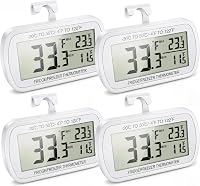
A thermometer tells you whether the fridge is cooling poorly or the dial just isn't set where you think. A digital model with a max/min record shows how cold the interior gets between door openings.
The VOULOIR thermometer reads from -4°F to 122°F with 0.2°F resolution and an accuracy of ±2°F. It runs on an included CR2032 battery and switches between °C and °F with one button.
Place one on a middle shelf, away from the walls and the door.
Compare the reading with our guide to how cold a mini fridge should be. If the interior stays well above that range with the dial at its coldest, airflow or a component issue is more likely.
What causes ice buildup inside a mini fridge?
Ice on the back wall or around the evaporator means moisture is freezing where it shouldn't. That often comes from a door left open, warm food placed inside, or a drain that's blocked.
Check the door seal first. Wipe the gasket clean and run a finger along its edge; a gap or a stiff, cracked gasket lets warm, humid air in, and that moisture freezes on the coldest surface.
If the unit has a small defrost drain, look for food or debris blocking it. A blocked drain traps water that can freeze and build up.
Empty the fridge and let any frost melt with the door open. Don't chip at ice with a knife or scraper, since that can puncture the liner or the evaporator.
Once it's clear, dry the interior and restart the fridge.
How do you check the door seal and hinges?
A tight seal is one of the easiest things to confirm and one of the most common causes of poor cooling. Test it with a sheet of paper or a quick visual check.
Close the door on a strip of paper so half stays outside. If you can pull the paper out easily, the seal is weak at that spot.
Repeat around the door.
Wipe the gasket with a damp cloth to remove sticky residue. A hair dryer on its lowest setting can soften a stiff seal, held a few inches away while you press the gasket back into shape.
Check the hinges too. A door that sags or doesn't line up evenly won't seal no matter how good the gasket looks.
Tighten loose screws and see whether the door sits flush.
Why is your mini fridge noisy or vibrating?
Some hum and gurgle is normal, but a rattle or repeated click is worth checking. The fix is often as simple as leveling the unit or moving something that touches the cabinet.
Listen closely to locate the sound. A rattle from the back often means the fridge is touching a wall or another object.
A buzz against the floor can come from an uneven base.
Check the feet. Most mini fridges have adjustable leveling feet, and a unit that rocks will transmit vibration.
Turn the feet until the cabinet sits steady and the door swings without drifting.
A click that repeats every few minutes without the fridge getting cold can point to the compressor or thermostat cycling. That's the point to stop and consider service.
How can you measure whether the fridge is using too much power?
A plug-in meter shows whether the fridge draws a normal amount of power or something is wrong. It also tells you what the unit costs to run.
Unplug the fridge and plug the meter into the wall, then plug the fridge into the meter. Let it run through a normal cycle with the door closed.
Our guide to how many watts a mini fridge uses gives you the typical range to compare against.
The MECHEER meter shows power, energy, volts, amps, hertz, power factor, and cost on a 2.36 x 1.85 inch backlit screen. Its memory keeps the last reading after you unplug it.
It also warns with "OVERLOAD" on screen if a load exceeds the set limit.
If the fridge pulls far more than expected or trips the meter's overload warning, unplug it and have it checked. A fridge that runs constantly and never rests is also a sign to look closer.
How do you clean the coils and vents to restore cooling?
Dusty coils and blocked vents make the fridge work harder and cool worse. Cleaning them is a routine job you can do in about 15 minutes.
Unplug the fridge first. Pull it away from the wall and look at the back.
On many mini fridges the condenser is a black grid of tubes; on others the coils are hidden behind a vent panel.
Brush or vacuum the coils from top to bottom. A soft brush reaches between the fins better than a cloth.
Don't bend the fins or push hard on the tubes.
Clear any dust from the vent grille and the area around the compressor. Leave the fridge unplugged while you work, then plug it back in and let it cool down again.
Pick a brush that reaches the tight spots
A slim, flexible brush gets between coil fins and into vent slots where a rag can't go.
The TAICHODEER set includes flexible shafts that reach behind the fridge and into narrow gaps. The crevice brush has a detachable mini tweezer tucked in the handle for pulling out lint and hair.
The set is plastic and stainless steel and stores in a drawer.
Keep the pressure light. The maker notes the shafts have limited flexibility, so avoid excessive bending.
Wipe the brushes after use and let them dry.
When should you call for repair instead of troubleshooting?
Call a technician when the compressor doesn't run, the fridge leaks refrigerant, or the interior stays warm after every check. Those problems sit inside the sealed cooling system and aren't home fixes.
Signs to watch for include a compressor that clicks and shuts off, frost only in one spot, or a chemical smell. A fridge that's physically damaged, such as a punctured line or a cracked liner, also needs professional attention.
If the unit is under warranty, contact the maker before opening anything. Home repairs on a covered unit can void the coverage.
Before you give up, revisit the basics one more time: power at the outlet, clearance around the cabinet, a clean seal, and the dial setting. Many "dead" mini fridges come back to life after one of those fixes.
If you're planning to relocate the unit, read how to move a mini fridge so a rough move doesn't cause the next problem.
What's the right order for troubleshooting a mini fridge?
Work from the outside in: outlet, plug, setting, airflow, seal, frost, then the compressor. That order catches the cheap fixes first and tells you when a repair is the honest answer.
If the fridge won't power on, check the outlet and cord. If it powers on but won't get cold, look at clearance, dust, and the seal.
If it cools unevenly or ices up, check the door and the drain. If the meter shows a wild draw or the compressor clicks, stop and call for service.
Keep a thermometer and a plug-in meter on hand so you can see the real numbers instead of guessing. That's the simplest way to know whether your mini fridge needs a cleaning, a setting change, or a technician.
When you've ruled out the easy causes and the fridge still misbehaves, a repair call is the next step in how to troubleshoot a mini fridge without wasting money on parts.
Frequently asked questions
How long should a mini fridge take to get cold after plugging it in?
Give it several hours to reach its set temperature, especially a new unit or one that just moved. If it stays warm after that time, check power and airflow before assuming the cooling system failed.
Why does my mini fridge feel warm on the outside?
Many mini fridges shed heat through their side walls, so a warm cabinet is normal. Make sure the sides and back have room to breathe and aren't pressed against a wall or cabinet.
Can a mini fridge be repaired at home?
A few issues are home fixes, such as a dirty condenser, a loose plug, or an iced-over evaporator. Problems with the compressor or sealed refrigerant lines usually call for a technician.
Is a noisy mini fridge a sign of a problem?
Some hum, gurgle, and fan noise is normal. A loud rattle or clicking that repeats without cooling often points to a mounting or fan problem worth checking.